
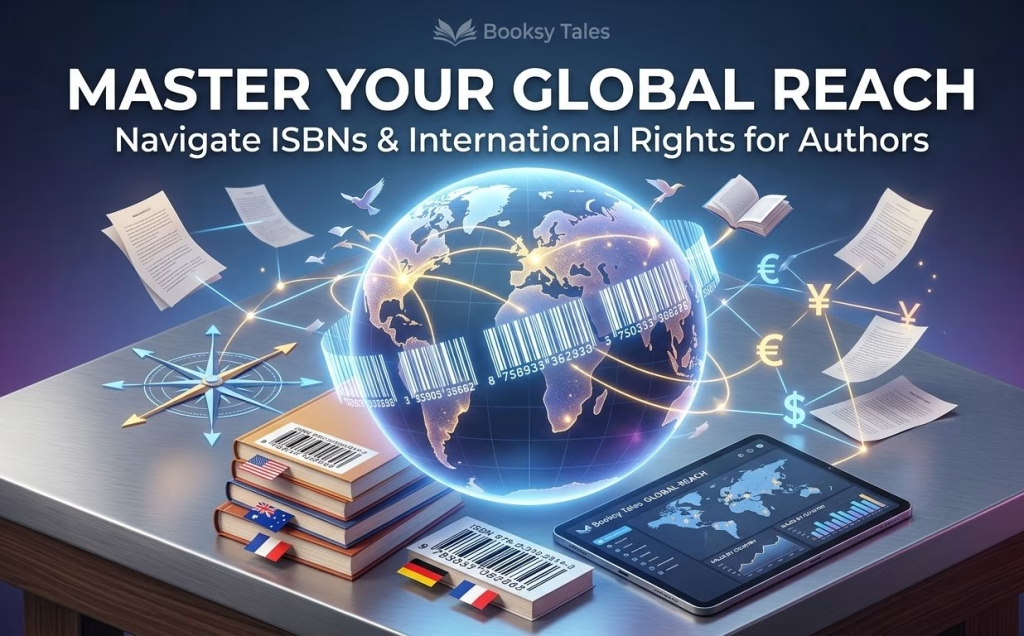
This comprehensive guide is designed for the modern author looking to move beyond the local market and establish a truly global presence. As the publishing landscape shifts in 2026, staying ahead of technical requirements like ISBNs and the nuances of international rights is no longer optional, it is the foundation of a scalable author business.
In the digital age, we often hear that the “world is a village.” For an author sitting at a desk in the United States, that means your potential readers are just as likely to be in London, Melbourne, or Berlin as they are in New York. However, simply clicking “Publish” on a single platform doesn’t make you a global author.
True global distribution is a deliberate strategy. It involves technical infrastructure, legal protections, and a deep understanding of how books move across borders. If you want your work to be discoverable in an indie bookstore in the UK or a library in Canada, you need more than just a great story. You need a passport for your book.
1. The ISBN: Your Book’s Universal Identity
The International Standard Book Number (ISBN) is the most misunderstood tool in an author’s kit. In the U.S., the only official agency for ISBNs is Bowker. While many platforms offer “free” ISBNs, these are rarely the bargain they seem to be for authors with global ambitions.
The “Free” ISBN Trap
Platforms like Amazon KDP often provide a free ISBN to help you get started. However, these numbers come with a significant catch: the platform is listed as the Publisher of Record.
- Portability Issues: If you use a free Amazon ISBN, you cannot take that same number to IngramSpark to reach physical bookstores or libraries. You are effectively “locked” into their ecosystem for that specific version of your book.
- Professional Perception: Retailers and libraries can see who the publisher of record is. A book published under “Independently Published” (the default for many free numbers) can sometimes face higher hurdles when trying to get into physical bookstores compared to a book published under your own custom imprint name.
The 10-Pack Strategy
In 2026, the cost of a single ISBN from Bowker remains a steep $125. However, savvy authors look at the 10-pack, which typically costs around $295.
Why do you need ten? Remember that every version of your book, the eBook, the paperback, the hardcover, and the audiobook, requires its own unique ISBN to be properly tracked in global databases. If you plan to write a trilogy, you’ve already used nine of those ten numbers. Buying in bulk brings your per-unit cost down significantly and ensures your metadata remains consistent across all territories.
2. Global Distribution Channels: Beyond the “Big A”
While Amazon is a titan, it is not the only player on the world stage. To be truly “wide,” you must diversify your distribution.
The Power of IngramSpark
For physical books, IngramSpark is the industry standard for reaching the “Global Reach” market. As of early 2026, IngramSpark updated its pricing structure, including a Market Access Fee (often referred to as a global distribution fee) that is now approximately 1.875% of the list price.
- Wholesale Discounts: Unlike KDP, IngramSpark allows you to set a wholesale discount (usually between 30% and 55%). To get your book into international bookstores, a 55% discount is often necessary so the retailer can cover their own importing and stocking costs while still making a profit.
- Returns: International bookstores are risk-averse. They are far more likely to stock an American indie author if the book is marked as “Returnable.”
Aggregators for Ebooks
For digital reach, aggregators like Draft2Digital or PublishDrive are essential. These services push your book to international retailers like Kobo (huge in Canada and Australia), Tolino (the market leader in Germany), and Vivlio (popular in France). By using an aggregator, you manage one dashboard rather than trying to navigate the tax and banking laws of a dozen different countries yourself.
3. Metadata: The Language of Discoverability
Metadata is the “behind-the-scenes” data that tells a search engine or a bookstore what your book is about. On a global scale, you have to speak two languages: BISAC and Thema.
BISAC Codes (US & Canada)
The Book Industry Standards and Communications (BISAC) codes are the standard in North America. In 2026, the list was expanded to include more granular categories like “Cozy Fiction” as its own top-level heading and “Speculative Fiction” for those “what-if” stories that don’t quite fit into traditional Sci-Fi. Choosing the right BISAC code ensures you aren’t buried in a general category where your target audience will never find you.
Thema (The Rest of the World)
While the U.S. relies on BISAC, the international market is increasingly moving toward Thema. Thema is a global subject category scheme that allows for “qualifiers.” For example, you can tag your book as a “Thriller” (Subject) but add a qualifier for “Setting: San Francisco” or “Time Period: 1940s.” This level of detail is how a reader in Japan finds your very specific niche book.
4. International Rights and the Translation Frontier
Selling a book in English is just the beginning. The most successful authors eventually look at Subsidiary Rights; selling the right for someone else to publish your book in a different language or format.
Translation Rights in the Age of AI
2026 has seen a massive shift in how translation rights are handled. Traditionally, an author would wait for a foreign publisher to buy the rights. Now, with high-quality AI-assisted translation, many indie authors are “self-translating” into high-volume languages like Spanish, German, and French.
- The Hybrid Approach: Authors use advanced AI for the first draft but hire a professional human editor in the target country to ensure cultural nuances and idioms are correct. This allows you to retain 100% of the royalties rather than selling the rights for a small advance.
Audio Rights
Don’t overlook audio. If you own your audio rights, you can distribute them globally through platforms like Findaway Voices. Audiobooks are currently the fastest-growing segment of the international market, especially in regions with long commute times or high mobile-phone penetration.
5. Pricing and Currency: The Logistics of “Global”
Pricing your book globally isn’t as simple as letting a computer convert $14.99 USD into other currencies.
- The VAT/GST Factor: In the U.S., sales tax is added at the register. In the UK and Europe, the price a reader sees; the Value Added Tax (VAT); is already included in the list price. If you don’t account for this, your royalty might be 20% lower than you expected because the government takes its cut from your “gross” price.
- Psychological Pricing: A book priced at $14.99 in the U.S. might convert to £11.42 in the UK. This looks unprofessional. You should manually set your prices to “clean” numbers like £10.99 or £11.99 to match local consumer expectations.
6. Legal Protection: Copyright and the Berne Convention
As a U.S. author, your primary protection is the U.S. Copyright Office. While copyright is technically “automatic” the moment you write the words, formal registration is your “big stick” in legal disputes.
Thanks to the Berne Convention, a copyright registered in the U.S. is recognized in over 170 countries. This is vital when dealing with international piracy or unauthorized translations. If you discover your book is being sold illegally on a foreign site, having that U.S. registration number makes the “Take Down” process much faster and more effective.
7. The Rise of Direct Sales
In 2026, many authors are realizing that “global distribution” can also mean selling directly to the reader. Platforms like Shopify and Kickstarter allow you to bypass the traditional retailers entirely.
By selling a digital file or a signed physical copy directly from your own website, you keep a higher percentage of the profit and, more importantly, you get the reader’s email address. This allows you to build a global community that you “own,” rather than being at the mercy of a retailer’s algorithm changes.
Why Global Matters for Your Next Promotion
At Booksy Tales, we focus on connecting authors with readers. But we’ve seen time and again that the most successful promotions happen when the author has “done the work” on their distribution.
When we send out our email newsletter to our thousands of subscribers, we want to make sure that no matter where that reader is; whether they are on a lunch break in Chicago or a train in Paris; they can click a link and buy your book instantly.
Global distribution is about removing friction. By owning your ISBNs, mastering your metadata, and thinking beyond the U.S. borders, you aren’t just an author; you’re a global entrepreneur.
Ready to take your book to the world?
If you have your global distribution in place and you’re ready for the world to see your work, we want to help.
- For Authors: Apply to have your book featured on the Booksy Tales website and newsletter. We specialize in helping indie authors find the global audience they deserve.
- For Readers: Sign up for our newsletter to discover your next favorite read from the world’s best independent authors.
Have you had success selling your books in international markets? What was your biggest hurdle? Share your experience in the comments below!
Looking for affordable book promotion services for indie authors? Contact us today to feature your book. Learn more about how to promote indie books online in our blog.
